As of late 2025, new State Bank of Vietnam (SBV) circulars have introduced stricter reporting for International Money Transfer Services in Vietnam to combat money laundering and streamline capital flows. Navigating these regulations is the key to a successful transaction.
Why International Money Transfers Matter in Vietnam?
Vietnam’s integration into the global supply chain has turned it into a hub for foreign direct investment (FDI) and international labor. Consequently, the demand for reliable International Money Transfer Services in Vietnam has surged.
Who Typically Needs International Transfers?
- Expats & foreign workers: Remitting monthly salaries after-tax to their home countries.
- Overseas Vietnamese (Việt Kiều): Sending remittances to support families or for local real estate investment.
- Foreign investors & SMEs: Injecting capital into new ventures or paying international vendors.
- Students & families: Paying for offshore tuition or receiving living stipends from relatives.
Common Use Cases
- Salary remittance.
- Investment capital.
- Family support.
Plan your budget effectively by gaining more insights into the Cost of living in Vietnam!
How International Money Transfers Work in Vietnam?
The process of moving money into or out of Vietnam is more regulated than in many Western countries due to foreign exchange controls.
Key Parties Involved
| Party | Definition |
| Sender | The individual or entity initiating the transfer. |
| Trasfer Provider | This can be a commercial bank (e.g., VIB, Vietcombank), a Money Transfer Operator (MTO), or a licensed fintech platform. |
| Intermediary Banks | Large global banks (like JP Morgan) that facilitate SWIFT transfers between smaller institutions. |
| Recipient | The person or business receiving the funds in their local currency. |
Step-By-Step Transfer Flow
Under Circular No. 20/2022/TT-NHNN (issued by the State Bank of Vietnam), the transfer money transfer process follows four steps.
- Step 1: You must provide a valid ID (Passport/TRC) and proof of the transfer’s purpose (e.g., a labor contract or invoice).
- Step 2: The provider applies an exchange rate. In 2025, the USD/VND rate has fluctuate between 26,250 and 26,350 VND.
- Step 3: The funds move through the SWIFT network or a proprietary fintech rail.
- Step 4: The recipient gets the money in their bank account or as a cash pickup.
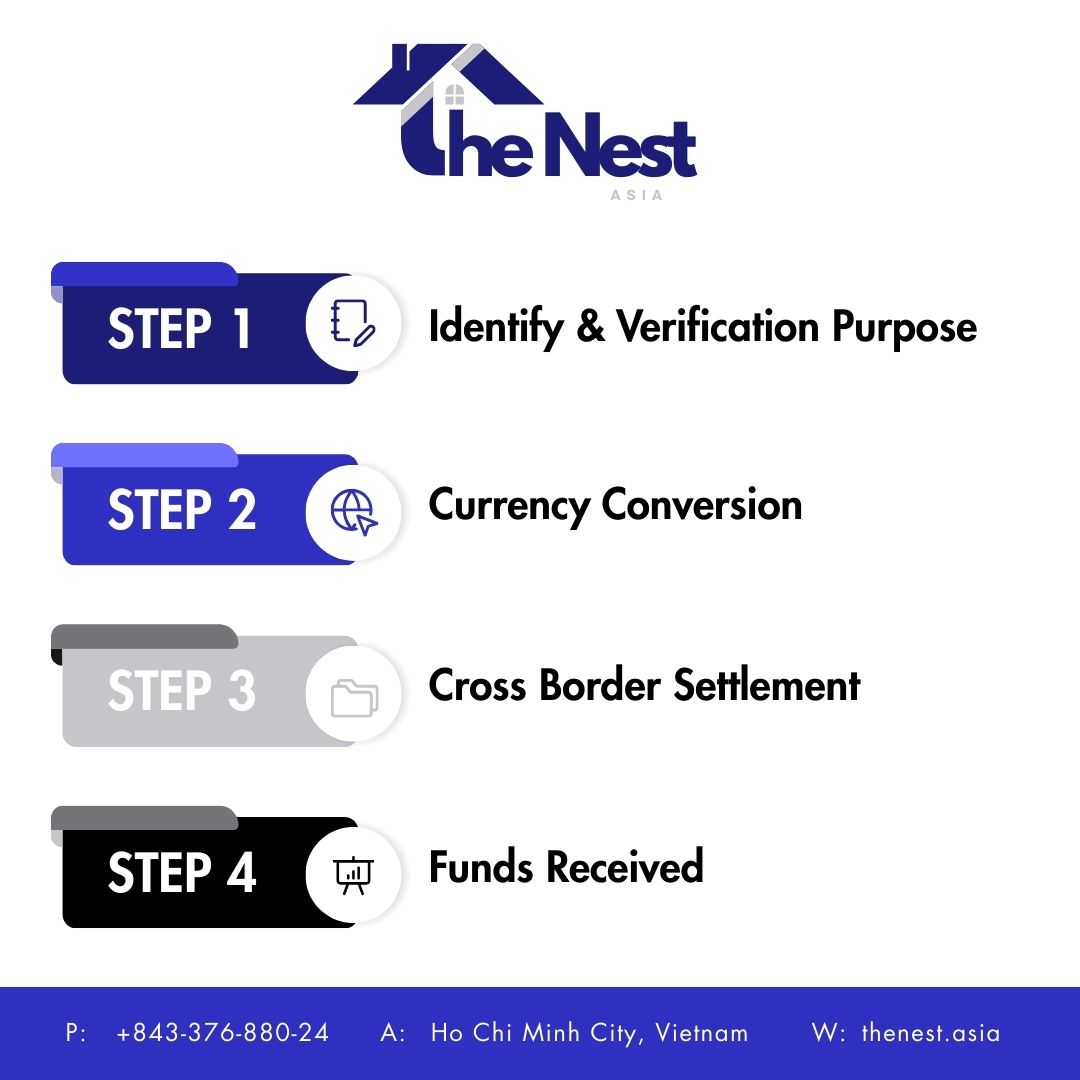
Four Steps of Money Transfer Flow
Typical Processing Times
- Fintech/MTOs: Within minutes or on the same day for small amounts.
- Bank transfers (SWIFT): Typically 1-5 business days, depending on the number of intermediary banks.
Delays are often caused by incomplete documentation, mismatched account names, or enhanced AML screening for transactions over US$1,000.
Types of International Money Transfer Services Available in Vietnam
Choosing the right provider depends on your transfer volume, urgency, and the degree of “compliance-heavy” documentation you can provide.
| Transfer Type | Popular Providers in Vietnam | Best For | Pros | Cons |
| Bank Transfer (SWIFT) | Vietcombank, VIB, HSBC | Large transfers, investments, and profit repatriation | High security, no legal cap on large transfers, integrated with investment accounts | Higher fixed fees, less competitive FX rates |
| Money Transfer Operators (MTOs) | Western Union, MoneyGram | Cash-based or urgent personal transfers | Wide agent network, easy cash pickup | High fees, FX markups |
| Digital & Fintech Platforms | Wise, Remitly | Salaries, family remittances, small–medium transfers | Transparent fees, fast processing, strong UX | Some features are restricted due to local regulations |
Legal & Regulatory Framework
Vietnam’s 2025 regulatory update is focused on transparency. The State Bank of Vietnam (SBV) has introduced several key circulars that affect how you move money.
State Bank of Vietnam (SBV) Regulations
Under Circular 27/2025/TT-NHNN, any international electronic transfer of US$1,000 or more must be reported to the SBV for anti-money laundering (AML) monitoring.
On the other hand, all parties in a remittance transaction must clearly state the purpose to allow banks to verify and store records.
Required Documents
| Transfer Purpose | Required Documents |
| Salary Remittance | Labor contract; Personal Income Tax (PIT) payment receipts |
| Business/Investment | Investment Registration Certificate (IRC); Audited financial statements |
| Education | Tuition invoices; School enrollment or admission letters |
Fees, Exchange Rate & Hidden Costs
The “cheapest” service isn’t always the one with the lowest fee; the exchange rate often hides the true cost.
Typical Fee Structures
- Fixed Sending Fees: Charged by the provider (e.g., US$5 or 1% of the total).
- Intermediary Bank Fees: Deducted by middleman banks in the SWIFT network (usually US$15–US$30).
- Receiving Bank Fees: Charged by the recipient’s bank to credit the account.
Exchange Rate Markups
Most providers add a “spread” to the mid-market exchange rate. While the market rate might be 25,000 VND, a bank might offer you 24,500 VND, effectively charging you 2% on the conversion.
How to Reduce Transfer Costs Legally?
- For transfers under US$1,000, apps like Wise often save 3-5% compared to banks.
- Since some bank fees are fixed, sending one large amount per month is cheaper than sending four small ones.
- Companies with high volume can often negotiate better FX margins with their primary bank.
International Money Transfers for Business & Investors
For 2026, business owners must pay close attention to the Circular 03/2025/TT-NHNN, which regulates Indirect Investment Accounts (IIA).
Foreign Direct Investment (FDI) & IIA
Foreign investors must use a đeicated IIA (in VND) at a licensed bank for indirect investments like buying shares or bonds. And if you move your IIA to a new bank, you must close the old one and transfer the entire balance to ensure a clear audit trail.
Profit Repatriation from Vietnam
Repatriating profits is a major concern for foreign enterprises. Under Circular 186/2010/TT-BTC, companies can only repatriate profits after:
- Fulfilling all tax obligations (CIT, VAT)
- Submitting audited financial statements to the tax authority.
- Providing a notice of profit remittance at least 7 working days before the transfer.
Risk & Challenges for Foreign Companies
- Transactions failing to meet the “legitimate purpose” criteria of Decree 329 may be frozen.
- The VND can be sensitive to global trade shifts; timing your transfer can save thousands of dollars.
- Always avoid “underground” transfer services (Chợ Đen). These are illegal and do not provide the documents required for future tax or audit purposes.
FAQs
- Is there a limit on sending money out of Vietnam?
For individuals, the limit depends on the purpose and your documented income. For businesses, there is no hard limit as long as the funds are legally earned and taxes are paid.
- Can foreigners open bank accounts in Vietnam?
Yes, foreigners with a valid visa or residence card for at least 6 months can open accounts.
- How long does an international transfer take in 2026?
Digital apps like Wise take minutes to 24 hours. Bank SWIFT transfers typically take 1 to 5 business days.
- Are online money transfer apps legal in Vietnam?
They are legal as long as they partner with local licensed banks or intermediaries. Always use well-known platforms like Wise, Remitly, or WorldRemit.
Making Transfers Smooth & Compliant
Whether you are using International Money Transfer Services in Vietnam for personal or business reasons, the best practice is to:
- Keep impeccable records of your income and taxes.
- Use licensed digital apps for speed and small amounts.
- Rely on established banks like VIB or Vietcombank for large capital movements.
About Us
The Nest Asia is a one-stop resource offering comprehensive information, practical relocation advice, cultural insights, valuable connections, and trusted services to help expatriates living in Vietnam navigate the transition, overcome challenges, and build a fulfilling life abroad. Starting your journey in a new country can often feel overwhelming. The Nest Asia is your trusted partner – we’re here to simplify that process and ultimately make Vietnam feel like home for you and your loved ones.
Discover more insightful blogs from The Nest Asia here!
Schedule a Meeting
Disclaimer: The Nest Asia is not an authorized provider of official government or non-government services. The information provided is intended for general guidance only. While we strive to offer accurate and timely information, we make no representations or warranties regarding its completeness or accuracy.